
My dwarf pomme cythere tree is a sensitive soul.
I’ve read that they can tolerate full sun, even in the tropics, but after a few days in a sunny spot my little tree wasn’t happy at all and started to droop. After moving him to a partially shaded area he’s much happier and his branches have stopped drooping.
Then I noticed what looked like tiny white beads on the underside of his leaves.
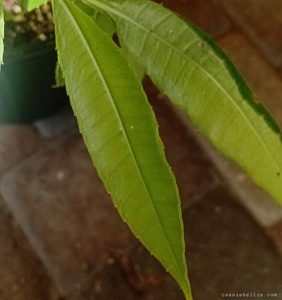
At first I thought they were insect eggs but there were no signs of any insects, or insect damage, anywhere on the tree. I used a little rubbing alcohol to wipe them off but by the next day they had returned.
After a little research I found this video that explains they could be produced by extrafloral nectaries. These are glands that produce nectar to attract beneficial insects (such as ants) and spiders to help protect the plant from herbivores. From my reading, the nectar that extrafloral nectaries produce isn’t involved in pollination.
Since I moved the tree to a shaded area there are now only a couple of “beads” scattered here and there. Perhaps heat was the stressor that prompted the extrafloral nectaries to produce nectar as it’s been unbearably hot recently. The tree looks healthy otherwise.
Photo taken by me.
Reading
1. de Oliveira Dias KP, Stefani V. Spider-Plant Interaction: The Role of Extrafloral Nectaries in Spider Attraction and Their Influence on Plant Herbivory and Reproduction. Plants (Basel). 2024 Jan 26;13(3):368. doi: 10.3390/plants13030368. PMID: 38337900; PMCID: PMC10857052.
2. Calixto ES, Moura RF, Lange D, Alves Silva E, Torezan-Silingardi HM, Del-Claro K. Multifunctional Roles of Extrafloral Nectaries in Shaping Plant-Insect Interactions. Plants (Basel). 2026 Feb 13;15(4):595. doi: 10.3390/plants15040595. PMID: 41754301; PMCID: PMC12944237.